

“Heroin eyes” describes visible changes in the eyes caused by heroin intoxication, the most recognizable one being “pinpoint pupils.”
When someone uses heroin or other opioids, the pupils often shrink to very small, fixed points, even in dim lighting. The eyes may also look glassy, heavy-lidded, or red.
If you are searching for information about “heroin eyes,” you may be worried about your own substance use or a loved one’s. Either way, it’s natural to want clear, trustworthy information.
This guide covers what heroin does to the eyes, how the signs shift during withdrawal, and what those signs do and do not tell you.
Need to Know
- Pinpoint pupils are the clearest eye sign of heroin use, often appearing within an hour.
- During withdrawal, the pattern reverses, and pupils tend to widen.
- Heroin can also cause heavy eyelids, a glassy look, and red or watery eyes.
- Pupil changes alone are not proof of heroin use, as other substances and health conditions can cause these as well.
What Do Heroin Eyes Look Like?
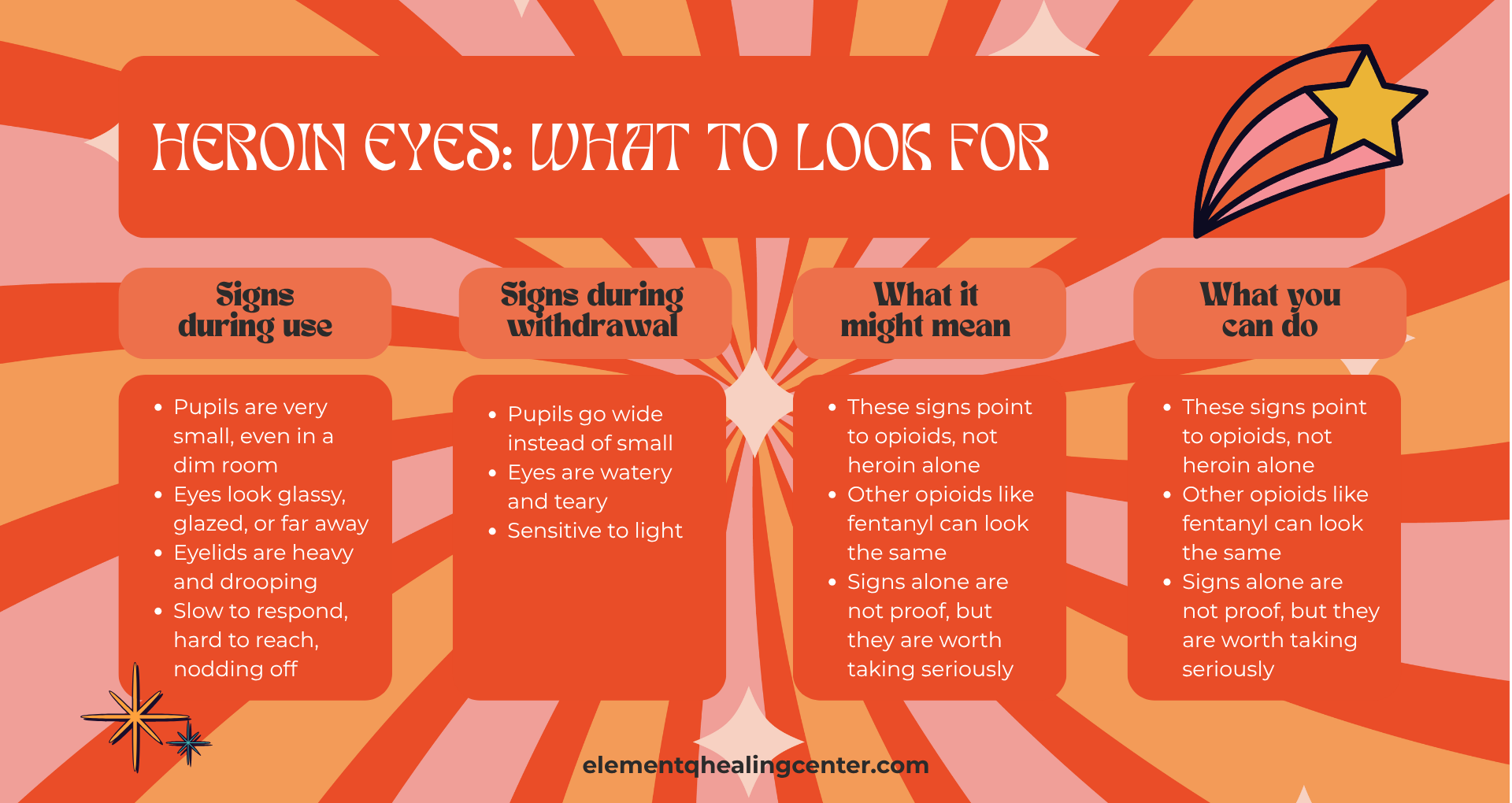
The most recognizable eye-related sign of heroin use is very small pupils. Heroin and other opioids narrow the pupils to pinpoint size, a change clinicians call miosis.
These often come with a cluster of other visible eye signs:
- Pinpoint pupils that stay small even in low light
- Slow or sluggish pupil response when light changes
- Heavy, droopy eyelids and a sleepy or “nodding” look
- A glassy or glazed appearance
- Red or watery eyes
These signs tend to show up soon after opioid use. Research published in the Indian Journal of Medical Research notes that opioid effects on the pupil can begin within 15 to 60 minutes and last several hours. [1]

Why Does Heroin Cause Pinpoint Pupils?
Heroin shrinks the pupils by acting on the brain’s opioid receptors.
Opioids, including heroin, stimulate a small structure called the Edinger-Westphal nucleus, which controls the muscles that constrict the pupil. [1] When heroin activates this pathway, the pupils tighten and stay small.
The effect is consistent enough that clinicians treat pupil size as a useful clue. The journal Neurology reported decades ago that pupil measurement can help separate heroin intoxication from withdrawal. [2]
One caveat: people who use heroin regularly can build tolerance, so the pupil change may be less obvious than in someone using it for the first time. [1]

How Do the Eyes Change During Heroin Withdrawal?
During heroin or opioid withdrawal, the eyes often do the opposite of what they do during use. Instead of shrinking, the pupils tend to widen, sometimes unevenly. [1]
Other eye-related signs of opioid withdrawal can include:
- Dilated pupils
- Watery, teary eyes
- Sensitivity to light
A less common but notable effect is sudden double vision. Some people develop a type of eye misalignment called acute esotropia when they stop using heroin, reported in roughly 30 percent of individuals following heroin withdrawal. [1] A case series in Eye described this same misalignment improving with treatment. [3]
For many people, these changes lessen as withdrawal passes.
What Other Eye and Vision Problems Can Heroin Cause?
Beyond pinpoint pupils, heroin can affect the eyes in other ways. The more serious ones tend to show up over time, especially with long-term injection use. [1]
Possible effects include:
- Brief disturbances in eye movement or focus after injecting
- Serious risks tied to injection use, such as infection inside the eye or blocked blood vessels in the retina, which can severely compromise vision and eye health
The more serious complications are less common, but important to be aware of, as some can permanently affect eyesight. If you use heroin or other opioids and notice eye pain, redness that will not clear, or vision changes, those are signs to seek medical care.
If you’re seeking LGBTQIA+ affirming addiction treatment for yourself or a loved one, Element Q Healing Center offers outpatient programs for queer and trans individuals in San Diego. Connect with our team to learn more.
Can Pinpoint Pupils Always Be Blamed on Heroin?
No. Pinpoint pupils point toward opioids, but they are not proof of heroin use specifically. [1]
Several things can cause the pupils to constrict, or get smaller, including:
- Other opioids, such as prescription pain medication, methadone, or fentanyl
- Certain medical conditions affecting the nervous system
- Some eye drops and other medications
It also helps to know that stimulants have the opposite impact on the eyes. Drugs like cocaine and methamphetamine widen the pupils rather than shrink them. Eye-related signs and symptoms can give us an idea of what may be going on pertaining to someone’s substance use, but they cannot replace an honest conversation or a medical assessment.
What Can You Do if You Notice These Signs?
Noticing these signs in yourself or someone else can bring up a lot of emotions. There is no single right next step, and you get to decide what feels safe.
A few options people find helpful:
- Talk with a medical provider or an LGBTQIA+-affirming provider who understands substance use
- Reach out to someone you trust
- Learn about structured outpatient programs, which can offer intensive support while letting you return home each night and continue living your daily life
Outpatient substance use programs, such as partial hospitalization and intensive outpatient programs, are built for that in-between space, where someone wants real support, but doesn’t require 24/7 inpatient care. For LGBTQIA+ individuals, affirming options matters because treatment tends to work better when you feel safe, heard, and seen.

How Element Q Can Help
At Element Q Healing Center, our all-LGBTQIA+ clinical team provides trauma-focused care for people navigating heroin and other opioid use. Through our partial hospitalization and intensive outpatient programs, we offer structured support that addresses substance use alongside the trauma and mental health concerns, as we know they often play a role.
If you have questions about identity-affirming treatment, you are welcome to reach out whenever you are ready. You can connect with our team via our contact page or by calling 858-422-1860 to discuss your options.
Embrace Your Truth, Find Your Folx.
Frequently Asked Questions
Do heroin eyes go away?
Yes, the most common effects of heroin use on the eyes are temporary. Pinpoint pupils and the glassy, heavy-lidded look fade as the drug leaves the body, and withdrawal-related changes like dilated pupils also resolve with time. Some complications from injection use can be lasting, though, so new eye pain or vision changes are worth checking with a medical provider.
Can you tell if someone is using heroin just from their eyes?
Not reliably. Pinpoint pupils strongly suggest opioids, but other opioids, some medications, and certain health conditions can cause similar effects. Pinpoint pupils and other eye signs can raise a reasonable concern, but they are not a diagnosis. A caring, nonjudgmental conversation or medical assessment can tell you far more.
Why does heroin make pupils so small?
Heroin acts on opioid receptors in the brain that stimulate a structure called the Edinger-Westphal nucleus. This pathway controls the muscles that constrict the pupil, so pupils shrink and remain small during opioid use. People who use regularly may show a less dramatic change because of tolerance.
What do the eyes look like during heroin withdrawal?
During withdrawal, pupils usually dilate rather than constrict, and the eyes can become watery and sensitive to light. Some people also experience sudden double vision due to a temporary misalignment of the eyes. These changes can be distressing in the moment, but they do tend to improve as withdrawal progresses.
Are heroin's effects on the eyes dangerous?
The everyday pupil and eyelid changes associated with heroin use are not harmful on their own. The bigger concern is injection use, which carries risks like eye infections and blocked retinal blood vessels that can affect vision. Persistent redness, pain, or changes in sight are reasons to seek medical care promptly.
Sources
[1] Dhingra, D., Kaur, S., & Ram, J. (2019). Illicit drugs: Effects on eye. Indian Journal of Medical Research, 150(3), 228–238. https://pmc.ncbi.nlm.nih.gov/articles/PMC6886135/
[2] Robinson, M. G., Howe, R. C., Varni, J. G., Ream, N. W., & Hegge, F. W. (1974). Assessment of pupil size during acute heroin withdrawal in Viet Nam. Neurology, 24(8), 729. https://www.neurology.org/doi/10.1212/WNL.24.8.729
[3] Firth, A. Y. (2001). Heroin withdrawal as a possible cause of acute concomitant esotropia in adults. Eye, 15(2), 189–192. https://www.nature.com/articles/eye200158