
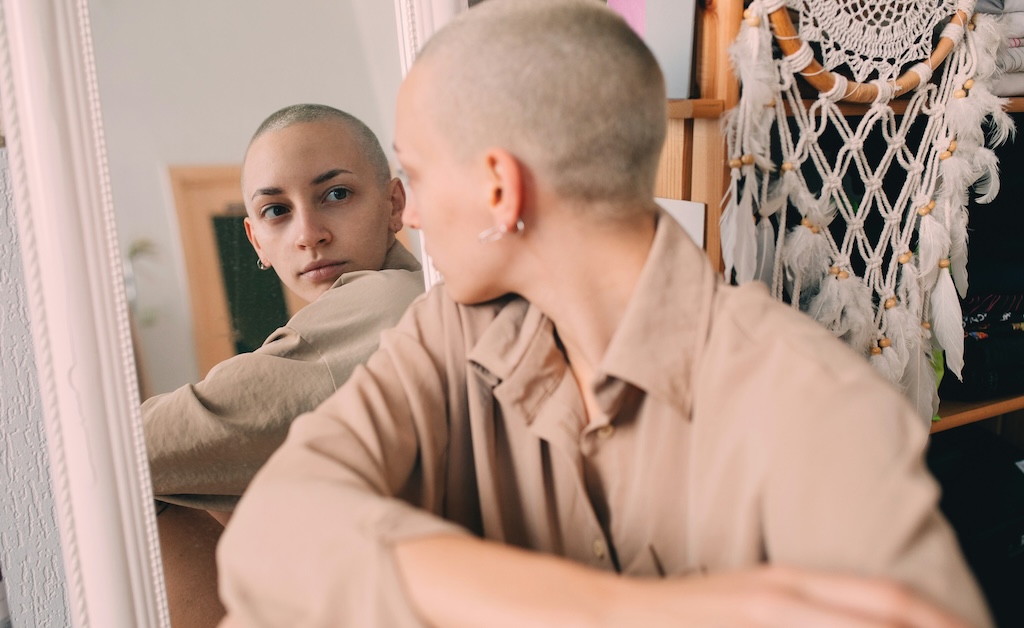

These two terms may sound similar, but gender dysphoria and body dysmorphia describe fundamentally different experiences, with different causes, different clinical meanings, and different paths toward support.
Gender dysphoria refers to the distress that can arise when a person’s gender identity doesn’t align with the sex they were assigned at birth. Body dysmorphic disorder (BDD)—sometimes called body dysmorphia—is a separate mental health condition involving perceived flaws in one’s appearance that others often can’t see. These are not the same thing, and if you’re someone trying to make sense of what they’re feeling, knowing the difference can bring real clarity. Let’s explore both terms.
What to Know
- “Gender dysmorphia” is not a clinical term—the correct term is “gender dysphoria,” and the two are frequently confused.
- Gender dysphoria involves distress rooted in a real mismatch between gender identity and the body; body dysmorphia involves a distorted perception of physical appearance.
- Both conditions can affect LGBTQIA+ individuals and can co-occur—but they require different approaches to treatment.
- Minority stress significantly shapes how both experiences show up for queer and trans people.
- Affirming, identity-informed care makes a meaningful difference for people navigating either experience.
What Is Gender Dysphoria—and What Does “Dysmorphia” Actually Mean?
The phrase “gender dysmorphia” doesn’t exist as a clinical diagnosis. It’s one of the most common misspellings of “gender dysphoria“—understandable given how similar the words sound—but they refer to entirely different things.
Gender dysphoria, as defined in the DSM-5, is the distress that may arise when a person’s deeply held gender identity does not match the sex they were assigned at birth. That distress can look like:
- Discomfort with specific body features
- A persistent sense of being misunderstood or misgendered
- Difficulty navigating a world that doesn’t reflect who you are
It’s important to note that not every transgender or gender-diverse person experiences dysphoria. For those who do, the intensity and focus of that distress can vary widely—and can shift over time.
“Dysmorphia,” on the other hand, comes from body dysmorphic disorder (BDD)—a condition characterized by distorted perception of physical appearance. The two terms share a root but describe fundamentally different experiences.
What Is Body Dysmorphic Disorder?
Body dysmorphic disorder is a mental health condition classified in the DSM-5 as an obsessive-compulsive spectrum disorder, meaning it’s closely related to OCD. BDD involves persistent, intrusive preoccupation with a perceived physical flaw—one that is either minor or entirely undetectable to others. The person experiencing BDD isn’t choosing to fixate; the thoughts are difficult to control and can feel overwhelming.
Common signs of BDD include:
- Repetitive mirror checking or avoiding mirrors entirely
- Excessive grooming or skin picking
- Repeatedly seeking reassurance from others about appearance
- Wearing specific clothing to conceal perceived flaws
- Difficulty concentrating on daily tasks due to appearance-related thoughts
The perceived defect can involve any body part. The face, skin, and hair are most commonly reported—likely because these areas receive the most social attention and scrutiny in daily interactions. BDD can also center on body size or weight, which is why it sometimes co-occurs with disordered eating, though the two are distinct conditions. It can additionally involve areas like the chest or genitals, which is one
What Is Body Dysmorphic Disorder?
Body dysmorphic disorder is a mental health condition classified in the DSM-5 as an obsessive-compulsive spectrum disorder, meaning it’s closely related to OCD. BDD involves persistent, intrusive preoccupation with a perceived physical flaw—one that is either minor or entirely undetectable to others. The person experiencing BDD isn’t choosing to fixate; the thoughts are difficult to control and can feel overwhelming.
Common signs of BDD include:
- Repetitive mirror checking or avoiding mirrors entirely
- Excessive grooming or skin picking
- Repeatedly seeking reassurance from others about appearance
- Wearing specific clothing to conceal perceived flaws
- Difficulty concentrating on daily tasks due to appearance-related thoughts
The perceived defect can involve any body part. The face, skin, and hair are most commonly reported—likely because these areas receive the most social attention and scrutiny in daily interactions. BDD can also center on body size or weight, which is why it sometimes co-occurs with disordered eating, though the two are distinct conditions. It can additionally involve areas like the chest or genitals, which is one reason it sometimes gets conflated with gender dysphoria.
How Does BDD Affect Daily Life?
At the core of BDD is a disconnect between what’s actually there and what the brain perceives. This is why cosmetic or surgical procedures rarely bring lasting relief from BDD symptoms—because the issue isn’t the body part itself, but rather, the individual’s perception of it. Without addressing the thought patterns driving the distress, concerns tend to shift to a new area or persist even after physical changes.
Treatment for BDD typically involves:
- Cognitive-behavioral therapy (CBT), specifically with exposure and response prevention—a technique that helps people gradually face appearance-related anxiety without giving in to compulsive behaviors like mirror checking or reassurance-seeking. Over time, this breaks the cycle that keeps BDD going.
- Medication, particularly SSRIs, can help reduce the anxiety and obsessive thoughts that fuel BDD
- Ongoing therapeutic support to help interrupt the cycle of fixation and compulsive behaviors over time
Gender Dysphoria vs. Body Dysmorphia: A Side-by-Side Comparison
Both conditions involve distress related to the body—but what’s actually driving that distress is very different, and so is what helps. The key distinction comes down to one question: is the perception of the body accurate, or distorted?
|
Gender Dysphoria |
Body Dysmorphia |
|
|
Perception of the body |
Accurate |
Distorted |
|
Source of distress |
Identity incongruence |
Misperceived flaw |
|
Others see the same thing? |
Yes |
Typically no |
|
Primary treatment |
Affirming care, identity support |
CBT, SSRIs |
|
Role of body modification |
May be part of affirming care |
Generally not recommended |
A transgender man who experiences distress about having breasts is not misreading his body—those characteristics are genuinely there, and his distress reflects the gap between his identity and his physical form. In BDD, the brain is misrepresenting the body—exaggerating a minor feature or generating concern about a flaw that others simply cannot see.
Related


Can Gender Dysphoria and Body Dysmorphia Co-Occur?
Yes—and for some LGBTQIA+ individuals, both experiences may be present at the same time. A trans woman might experience dysphoria related to certain physical characteristics while also developing BDD-related distress about an entirely separate feature. These experiences can happen in parallel without one causing the other.
Research published in Child and Adolescent Psychiatry and Mental Health found that how someone experiences gender dysphoria versus body dissatisfaction can actually be shaped by different kinds of stress in their life. For example, experiencing transphobia was more strongly linked to gender dysphoria, while social rejection and poor peer relationships were more tied to body dissatisfaction.
In other words, the world around you—how safe you feel, whether you’re accepted, whether you’ve faced discrimination—directly affects how these experiences show up in your body and your sense of self.
Why Does It Matter That Gender Dysphoria and Body Dysmorphia Are Not the Same Thing?
This isn’t just a question of terminology—it has real consequences both clinically and ethically.
When gender dysphoria is treated as a form of dysmorphia, it implies that being trans is a distorted thought pattern to be corrected, rather than a real and valid part of who someone is. This misunderstanding has historically been used to:
- Deny gender-affirming care
- Justify conversion-oriented treatments now understood to be harmful
- Treat trans and nonbinary identity as a disorder rather than a human experience
At the same time, LGBTQIA+ individuals navigating body image distress deserve support that accounts for how discrimination, healthcare trauma, and minority stress shape their relationship with their bodies. Research consistently shows that transgender individuals report significantly higher body dissatisfaction than cisgender peers and that experiences of transphobia compound this distress.
A provider who genuinely understands both conditions is better equipped to offer mental health treatment that actually helps. For people sorting through complicated feelings about their body and identity, identity-affirming outpatient programs that center LGBTQIA+ lived experience can offer a supported space where those feelings can finally be explored and understood.
What Does Treatment for Gender Dysphoria Look Like?
Affirming care is the evidence-supported approach for gender dysphoria. Research has found that gender-affirming care is associated with improvements in mental health outcomes for transgender youth, while conversion-oriented approaches are associated with increased suicidality. The type of care someone receives—and whether it truly affirms who they are—makes a huge difference.
Affirming care centers the person’s identity and autonomy. It may include:
- Working with clinicians who understand gender identity and its relationship to mental health
- Exploring social transition options (name, pronouns, presentation) at one’s own pace
- For some people, medical options — all approached collaboratively and without coercion
- Addressing the impacts of minority stress as part of treatment
- Community connection with other LGBTQIA+ people, which can meaningfully reduce distress
When both gender dysphoria and BDD are present at the same time, treatment that addresses each experience while centering the person’s identity is most effective.
Get Support for Gender Dysphoria
If you’re sitting with questions about your body, your identity, or what support might be most helpful for you, you’re not alone. We’re here when you’re ready. Your privacy is respected throughout every step of the process.
Frequently Asked Questions (FAQs)
1. What is the difference between gender dysphoria and body dysmorphia?
Gender dysphoria is distress that arises from a mismatch between a person’s gender identity and the sex they were assigned at birth. Body dysmorphic disorder (BDD) is a separate mental health condition involving obsessive preoccupation with a perceived physical flaw that others typically can’t see. The key distinction: in gender dysphoria, the person is perceiving their body accurately—the distress comes from a real incongruence with their identity. In BDD, the perception itself is distorted. They are separate conditions with different causes and different treatment approaches, though they can both be present at the same time.
2. Why is gender dysphoria not treated like body dysmorphia?
Because the experiences are fundamentally different. In BDD, the goal of treatment is to correct distorted thinking and reduce compulsive behaviors, which is why physical body modification is generally not recommended. In gender dysphoria, the person’s perception of their body is accurate. The distress comes from a true disconnection with their gender identity, not a misperception. Affirming treatment may include psychosocial support, social transition, and, for some people, medical options. Treating gender dysphoria as dysmorphia can cause real harm and is not supported by current evidence-based care standards.
3. What is the difference between gender dysphoria and gender incongruence?
Gender dysphoria, as defined in the DSM-5, refers specifically to the distress that can come with a mismatch between gender identity and sex assigned at birth. Gender incongruence—the term used in the ICD-11—describes the mismatch itself, without requiring distress to be present. Not every gender-diverse person experiences dysphoria, and the move toward “gender incongruence” as a classification reflects an effort to recognize trans identity as a human experience rather than a disorder, while still ensuring people can access the care they need.
4. Does BDD ever go away?
BDD is a chronic condition for many people, but it is treatable. With the right support, many people experience a significant reduction in symptoms and improved quality of life. Some people achieve full remission; others manage symptoms over time. Early identification matters, and for LGBTQIA+ individuals especially, finding a provider who understands the difference between BDD and identity-related concerns is an important part of getting treatment that actually helps.
4. What is bigorexia, and how does it relate to body dysmorphia?
Bigorexia—also called muscle dysmorphia—is a subtype of BDD where a person becomes preoccupied with the belief that their body isn’t muscular or large enough, despite often being quite physically developed. It shares BDD’s core feature of distorted perception and can interfere significantly with daily life and physical health. It’s more commonly reported among men and can involve compulsive exercise, restrictive eating, and sometimes performance-enhancing substances. Treatment approaches are similar to those used for other forms of BDD.