

GHB side effects include sedation, confusion, memory loss, slowed breathing, loss of coordination, and nausea.
This page provides essential information about GHB’s effects, overdose signs, withdrawal risks, and immediate safety steps to help you make informed decisions and access support when needed.
Whether you’re seeking information for yourself or a loved one about substance misuse, understanding the realities of GHB use is an important step toward safer choices and healing.
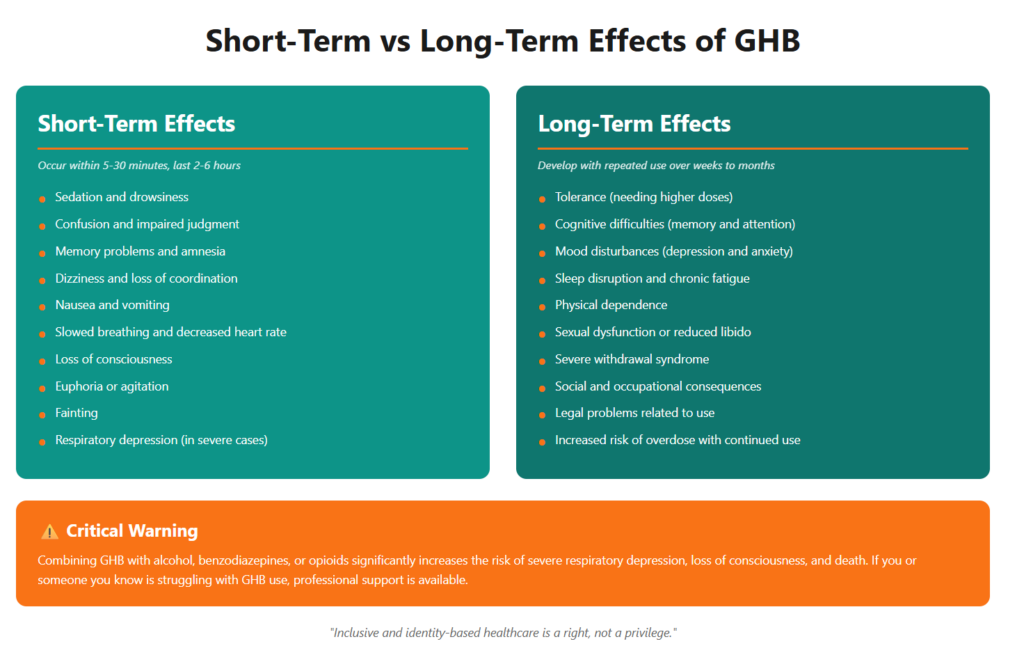
Short-Term vs Long-Term Effects of GHB: Quick Guide
What Is GHB?
GHB (gamma-hydroxybutyrate) is a central nervous system depressant that carries significant health risks, particularly for members of the LGBTQIA+ community, where its use has been documented at higher rates in certain social contexts.
Other names for GHB:
- Liquid ecstasy
- G
- Liquid X
- Liquid E
- Fantasy
- Grievous Bodily Harm
- Georgia Home Boy
- Goop
- Gamma-oh
- Easy Lay
- Scoop
How is GHB used?
GHB is typically taken orally as a liquid, often mixed into drinks, or less commonly as a powder dissolved in liquid.
Because it’s colorless and nearly odorless, it can be difficult to detect when added to beverages. Users may measure doses in bottle caps or small vials, though inconsistent potency makes accurate dosing nearly impossible with illicit products.
How GHB Affects the Body: What You Need To Know
GHB affects the body by depressing the central nervous system, slowing brain activity, breathing, and heart rate while causing sedation, confusion, and memory impairment. Here’s everything you need to know to stay safe:
Onset and Duration of GHB
When taken orally, GHB is absorbed rapidly. Effects typically begin within 5 to 30 minutes, peak within 30 minutes to 1 hour, and commonly last 2 to 6 hours depending on dose, individual factors, and whether other depressants are present.
Food can slow absorption and alter the timing of effects, which significantly impacts overdose risk. This rapid time course helps explain why overdose can happen quickly and why timely recognition matters for safety and emergency care.
Short-Term Side Effects of GHB
Common immediate effects reported with GHB, GBL, or 1,4-BD use include:
- Sedation, drowsiness, and reduced responsiveness
- Confusion, impaired judgment, and memory problems, including amnesia
- Dizziness, nausea, and vomiting
- Slowed breathing and decreased heart rate
- Loss of coordination and fainting
- Mood changes ranging from euphoria to agitation
Long-Term Effects of GHB
With repeated or frequent use, people often develop tolerance and physical dependence. Potential long-term effects associated with regular use include:
- Needing increasing doses to achieve the same effect
- Cognitive difficulties, including memory and attention problems
- Mood disturbances such as depression and anxiety
- Sleep disruption and chronic daytime fatigue
- Sexual dysfunction or reduced libido
- Social, occupational, and legal consequences related to use patterns
The likelihood and severity of these effects vary across individuals based on frequency of use, dose, co-occurring mental health conditions, and other factors.
How to Recognize a GHB Overdose:
Severe GHB intoxication can rapidly progress to life-threatening respiratory depression, coma, and aspiration. Concerning signs of overdose include:
- Marked unresponsiveness or extreme difficulty waking the person
- Very slow, shallow, or irregular breathing
- Slow heart rate or dangerously low blood pressure
- Repeated vomiting while unresponsive
- Seizures or severe agitation
What to Do If You Suspect a GHB Overdose:
If you suspect someone is experiencing a GHB overdose, immediate action can save their life:
- Call 911 immediately – Clearly describe suspected GHB, GBL, or 1,4-BD exposure
- Check responsiveness and breathing – If breathing is inadequate, begin rescue breathing or CPR if you’re trained
- Use the recovery position – Place an unconscious but breathing person on their side to reduce aspiration risk
- Do not give anything by mouth – Never give water, food, or other substances to an unresponsive person
- Do not induce vomiting – This increases aspiration risk
- Gather evidence – Collect any containers, product labels, or witness information for medical responders
- Report all substances – Tell emergency personnel about any alcohol, prescription medications, or other drugs that may have been used
Important note: Naloxone (Narcan) is not effective for reversing GHB overdose, though it may be administered if opioid co-ingestion is suspected while awaiting emergency help.
These immediate steps reduce harm and help emergency teams stabilize the person’s airway, breathing, and circulation upon arrival.
GHB Withdrawal: Signs & Symptoms
Regular GHB use can lead to withdrawal syndrome when doses are reduced or stopped. Unlike many substances, GHB withdrawal can be medically serious and potentially life-threatening.
GHB withdrawal symptoms:
Symptoms may begin as soon as a few hours after the last dose and typically include:
- Anxiety, agitation, and increased heart rate
- Insomnia, tremor, and profuse sweating
- Nausea and vomiting
- Confusion, hallucinations, and paranoid thoughts in severe cases
- Seizures and autonomic instability in severe withdrawal
GHB withdrawal timeline:
Acute withdrawal commonly lasts several days to a week, though severe or complicated withdrawal may require longer medical monitoring and can persist in a protracted form for weeks in some individuals.
Medical supervision is essential: Withdrawal management often requires supportive care and medication protocols, typically including benzodiazepines, administered under medical supervision. Never attempt to stop regular GHB use without professional support.
How Medical Professionals Diagnose GHB Intoxication
In emergency settings, GHB intoxication can look similar to other central nervous system depressant overdoses. Clinicians distinguish GHB cases using several factors:
- Rapid onset and relatively short duration of deep sedation compared to typical alcohol effects
- History of abrupt recovery within hours in some cases
- Memory loss with relatively preserved vital signs early in the presentation
- Specialized toxicology testing when available
Because routine drug screens don’t reliably detect GHB, timely specimen collection and specialized testing such as gas chromatography-mass spectrometry may be required. Clinical management prioritizes airway and breathing support regardless of the specific substance involved.
Detection Windows for GHB
GHB is rapidly metabolized, resulting in a very short detection window:
- Blood: Usually detectable for 4 to 8 hours after ingestion
- Urine: Often detectable for 6 to 12 hours, sometimes longer depending on dose and sample timing
Precursors like GBL and 1,4-BD convert to GHB in the body and may slightly extend detectable signals depending on individual metabolism and testing methods. Because these windows are so brief, collecting samples as soon as possible after suspected use significantly improves the chance of detection.
The Risk of Adulterated Products
Illicit supply chains are inherently unpredictable. Products sold as GHB may contain adulterants, substitutions, or manufacturing byproducts that create additional health risks.
What’s Been Found in “GHB” Samples
Public health alerts have documented samples sold as GHB that actually contained:
- Methamphetamine or other stimulants
- Other psychoactive drugs
- Industrial solvents
- Manufacturing byproducts
- Caustic agents like sodium hydroxide (in rare cases)
These mismatches occur through mislabeling, cross-contamination, or deliberate substitution. The presence of caustic substances can cause chemical burns to the mouth, throat, or esophagus.
If Chemical Burns Occur
If someone experiences burning pain, drooling, difficulty swallowing, or visible oral injury after contact with a suspect liquid:
- Rinse the affected area gently with water
- Seek medical care immediately
- Do not induce vomiting
- Bring samples, containers, or photos to emergency personnel
While reagent test kits exist, they provide limited information and cannot identify all contaminants, making them an imperfect harm reduction tool.
Harm Reduction and Safety Strategies
For individuals who use or are around others using GHB or related compounds, these strategies can reduce immediate risks:
- Never mix with other depressants – Avoid combining GHB with alcohol, benzodiazepines, or opioids
- Start low and go slow – Use small, measured doses and wait to fully assess effects before considering more
- Account for food effects – Remember that eating can delay onset, potentially leading to accidental re-dosing
- Never use alone – Always have someone present who can call for help if needed
- Monitor closely – Never leave someone alone who appears highly sedated, is vomiting, or is hard to rouse
- Keep emergency contacts accessible – Know how to access emergency services and basic first aid
- Don’t test by tasting – If concerned about product contents, preserve containers for laboratory testing rather than sampling
- Seek medical guidance before stopping – Withdrawal can be severe and requires professional supervision
These practical steps support immediate safety and reduce the likelihood of life-threatening complications.
GHB Use and Sexual Assault
GHB has been used as a drug-facilitation tool in sexual assaults because it can be dissolved in liquids and causes sedation and memory impairment. These properties have been exploited when the substance is administered without consent.
Many reported cases involve GHB combined with alcohol or other drugs, which compounds risk and effects.
If You Suspect You’ve Been Drugged
If you or someone you know may have been drugged:
- Seek emergency medical care immediately
- Preserve any remaining drinks or containers
- Request a urine sample be collected as soon as possible (given the short detection window)
- Contact local authorities or sexual assault support services
- Ask about forensic evidence collection
Medical and legal professionals can provide specialized support, and many communities offer confidential sexual assault advocate services.
You Deserve Support and Healing
If you’re struggling with GHB use or are concerned about someone you care about, know that recovery is possible. At Element Q Healing Center, we understand that substance use in the LGBTQIA+ community often reflects deeper experiences of minority stress, discrimination, and trauma.
Our comprehensive Partial Hospitalization Program (PHP), Intensive Outpatient Program (IOP), and Outpatient Program (OP) provide identity-affirming care that addresses both substance use and co-occurring mental health conditions through evidence-based addiction treatment, trauma-informed care, and holistic healing practices.
All care is delivered by LGBTQIA+ practitioners who share lived experience within our community and understand that substance use often reflects deeper needs for connection, safety, and healing.
Contact Element Q today at (619) 432-5784 to learn more about our LGBTQIA+-affirming substance use treatment programs in San Diego, where your identity is celebrated as the foundation of your recovery.
“Inclusive and identity-based healthcare is a right, not a privilege.”
GHB Side Effect FAQs
Here are some questions people also ask about GHB side effects, risks of use, and more:
What are the cognitive effects of GHB?
GHB causes confusion, impaired judgment, memory problems, and amnesia. These cognitive effects can range from mild disorientation to complete memory blackouts, especially at higher doses.
What is a GHB-induced coma?
A GHB-induced coma is a state of deep unconsciousness caused by severe GHB intoxication where the person cannot be roused. This medical emergency requires immediate treatment as it can lead to respiratory failure, aspiration, and death.
What are the side effects of GHB?
GHB side effects include sedation, confusion, memory loss, slowed breathing, loss of coordination, and nausea. Severe cases can cause loss of consciousness, respiratory depression, and coma.
What are the symptoms of GBL withdrawal?
GBL withdrawal symptoms include anxiety, agitation, tremor, sweating, insomnia, nausea, increased heart rate, and in severe cases, seizures and hallucinations. Symptoms typically begin within hours of the last dose and require medical supervision.
What is used for GHB withdrawal?
Benzodiazepines are typically used to manage GHB withdrawal under medical supervision. Treatment also includes supportive care, vital sign monitoring, and medication to control symptoms like agitation and seizures.
What’s the best thing to do if you’ve been spiked?
Seek emergency medical care immediately and preserve any remaining drinks or containers for testing. Contact local authorities or sexual assault support services for medical and forensic assistance.
How to deal with someone drugged?
Call 911 immediately and stay with the person until help arrives. Place them in the recovery position if unconscious but breathing, monitor their breathing, and never leave them alone.
What calms down drunkenness?
Time is the only way to sober up as the body metabolizes alcohol. Stay hydrated, rest in a safe environment, and seek medical care if you suspect drug involvement beyond alcohol.
How to flush out spiked drink?
You cannot flush out a spiked drink from your system. Seek emergency medical care immediately, as specialized treatment may be needed depending on the substance involved and timely medical intervention can be life-saving.