

Gender identity is a person’s internal sense of who they are in terms of gender. Gender expression is how that gender is shown to the world through things like clothing, hairstyle, voice, and mannerisms. The two are connected but separate, and neither determines the other.
Understanding this distinction matters because it shapes how people experience themselves, how others see them, and how safe and supported they feel in everyday life. For LGBTQIA+ individuals especially, having space to explore both identity and expression is closely tied to mental wellness. Identity-affirming mental health care recognizes both as essential parts of who someone is.
This guide breaks down what each term means, how they differ, provides examples of each, and explains why the differences matter for mental health.
Need to Know
- Gender identity is internal; gender expression is external.
- Neither has to align with the sex you were assigned at birth.
- Expression doesn’t prove or determine identity.
- Both can shift over time, and that’s normal.
- Affirming environments support wellbeing across all identities and expressions.
What Is Gender Identity?
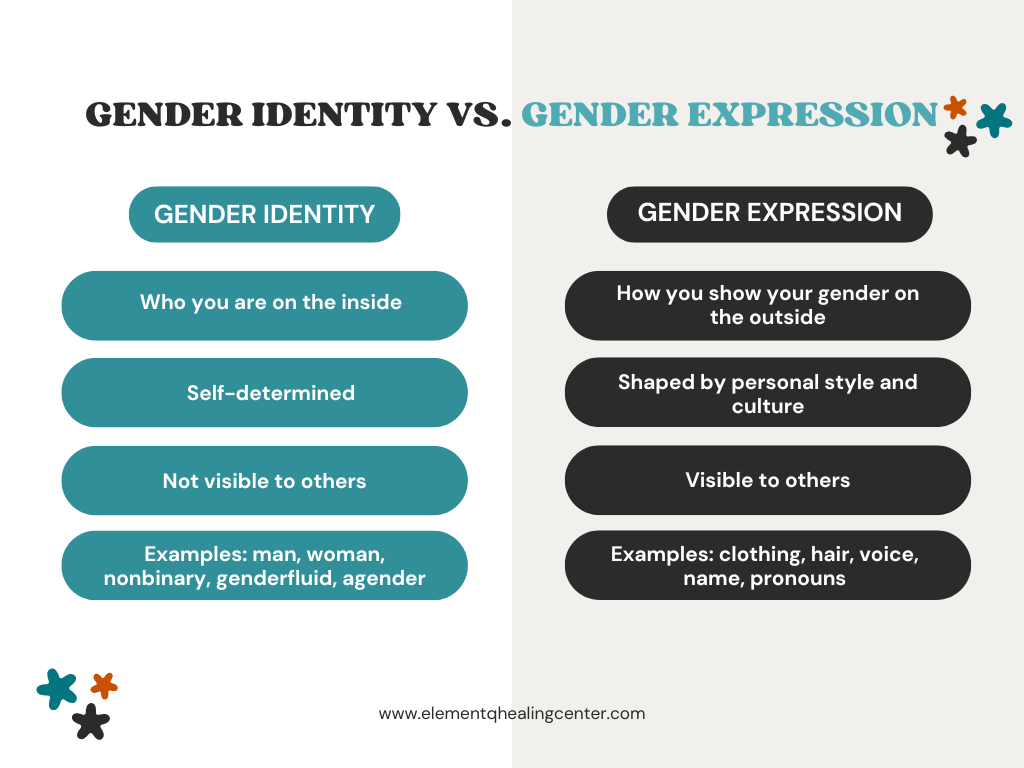
Gender identity is a person’s internal, deeply felt sense of being either a man, woman, both, neither, or another gender entirely. Gender identity is self-determined, meaning no one else can dictate another person’s gender [1].
Gender identity isn’t visible from the outside. Two people who look similar can have completely different gender identities. And someone’s identity may or may not align with the sex they were assigned at birth.
Identity is also distinct from sexual orientation. Gender identity is about who you are; sexual orientation is about who you’re attracted to [2].
What Is Gender Expression?
Gender expression is how a person outwardly shows their gender. This may include the clothing, hairstyle, voice, mannerisms, chosen names, and pronouns. It’s shaped by personal preference and the culture in which each individual lives [1].
Expression can be intentional or unconscious. It can also shift from day to day depending on someone’s mood, setting, or comfort level.
It’s important to note that expression isn’t always a free choice. Safety concerns, family dynamics, workplace expectations, and access to gendered items can all influence how someone expresses their gender, regardless of how they identify.
How Does Gender Identity Differ From Gender Expression?
The simplest way to understand the difference: identity is internal, expression is external. The way someone expresses their gender doesn’t have to match traditional expectations of their identity in order to be valid.
For example, a trans woman who dresses androgynously is still a woman. A cis man who paints his nails is still a man. A nonbinary person who presents in a way that reads as feminine or masculine is still nonbinary. Expression is a personal choice; identity is a personal truth.
It’s also worth noting that sex, identity, and expression are three separate things. Sex refers to chromosomes, hormones, and anatomy, and even sex isn’t strictly binary, as intersex variations exist [1]. The sex someone is assigned at birth doesn’t predict their gender identity or how they express it.
What Are Some Common Gender Identities?
There’s no single right way to describe your gender, and the language people use is always evolving. You might recognize yourself in one of the identities below, in several, or in none, and all of that is okay. Some commonly recognized identities include:
- Cisgender: When your gender identity matches the sex you were assigned at birth.
- Transgender: When your gender identity is different from the sex you were assigned at birth. Some transgender people pursue gender-affirming care; many do not.
- Nonbinary: A gender identity that isn’t strictly man or woman. Some nonbinary people also identify as transgender.
- Genderfluid: When your gender identity shifts over time or in different settings.
- Agender: When you don’t identify with any gender. Sometimes called genderless or gender-neutral.
- Genderqueer: When your gender doesn’t fit conventional expectations, often including multiple genders or a mix.
- Bigender: Identifying with two genders, either at once or at different times.
- Polygender or pangender: Identifying with or experiencing multiple genders.
- Omnigender: Identifying with and experiencing all genders.
- Androgyne: Identifying as both masculine and feminine, somewhere between, or a blend.
- Gender expansive: A broader term for people whose identity or expression goes beyond cultural norms for their assigned sex.
- Demigender: Partially identifying with one gender, like demigirl or demiboy.
- Two-spirit: An umbrella term used by some Indigenous Native American communities to describe gender and sexuality outside Western binary categories. The term is culturally specific to Indigenous peoples and isn’t used by people outside those communities.
This list isn’t exhaustive, and you don’t have to find the perfect word right away. People often try on different language before something feels right, and what feels right can change [1].
What Are Some Examples of Gender Expression?
Gender expression shows up in small and big ways. Common examples include:
- Clothes and personal style
- Hairstyle and grooming
- Voice, tone, and the way you speak
- Body language and mannerisms
- The name and pronouns you go by
- Makeup, jewelry, and accessories
Two people with the same gender identity can express themselves in completely different ways, and that’s normal.
Why Does Understanding the Difference Matter for Mental Health?
If you’ve ever felt drained from holding parts of yourself back, that exhaustion has a name. Researchers call the chronic strain of dealing with discrimination, misgendering, and pressure to hide who you are minority stress [3].
When you have to mask your identity or limit your expression for safety, the toll is real. According to The Trevor Project’s 2024 national survey of more than 18,000 LGBTQ+ young people, 39% seriously considered suicide in the past year, and 65% reported at least one mental health diagnosis [4].
The reverse is also true. The same survey found that LGBTQ+ young people living in very accepting communities attempted suicide at less than half the rate of those in very unaccepting communities [4]. Affirming environments don’t just feel better. They protect mental health.
How Element Q Can Help
At Element Q Healing Center, every clinician is part of the LGBTQIA+ community, and our trauma-focused care is built around the realities our clients actually live. If gender identity or expression has been weighing on your mental health, our IOP and PHP programs offer structured, affirming support without asking you to explain or defend who you are.
If you’re looking for care that respects every part of who you are, we’re here to answer questions. Reach out anytime to verify your insurance or call 858-422-1860 to learn more.
Frequently Asked Questions
1. What is the difference between gender identity and gender expression?
Gender identity is a person’s internal sense of their own gender. Gender expression is how they outwardly show that gender through clothing, hairstyle, voice, mannerisms, and other cues. Identity is internal and self-determined, while expression is external and influenced by personal choice, culture, and context.
2. Is gender expression part of gender identity?
How someone shows up on the outside often hints at who they are on the inside, though that’s not always the case. Plenty of people tone down or adjust how they express themselves for safety, family, or work, and none of that changes who they actually are.
3. What are examples of gender expression?
Gender expression shows up in everyday things like what someone wears, how they do their hair, makeup, jewelry, voice, the way someone moves, and the name and pronouns someone chooses to go by. It can look completely different from one person to the next, and it can shift from one day to the next, too. Personal taste plays a role, and so does the culture you’re living in.
4. Can gender identity and gender expression change over time?
Yes. Some people know who they are from a young age and never waver. Others figure it out more slowly, and what feels true can shift as they grow. Expression often changes too, depending on where you are, who you’re around, and what feels safe. Whether something stays the same or changes, it’s still real.
5. Does gender expression determine sexual orientation?
No, they’re two different things. How you dress, talk, or carry yourself doesn’t tell anyone who you’re attracted to. Orientation is about attraction; expression is about how you show your gender to the outside world.
References
[1] Shelton, J. (2023). Gender identity and gender expression. In C. Franklin (Ed.), Encyclopedia of social work. Oxford University Press. https://doi.org/10.1093/acrefore/9780199975839.013.1324
[2] American Psychological Association. (2023). Transgender people, gender identity, and gender expression. https://www.apa.org/topics/lgbtq/transgender-people-gender-identity-gender-expression
[3] Meyer, I. H. (2003). Prejudice, social stress, and mental health in lesbian, gay, and bisexual populations: Conceptual issues and research evidence. Psychological Bulletin, 129(5), 674–697. https://doi.org/10.1037/0033-2909.129.5.674
[4] The Trevor Project. (2024). 2024 U.S. National Survey on the Mental Health of LGBTQ+ Young People. https://www.thetrevorproject.org/survey-2024/